
Mugwort: For menstrual cramps and tension
“Sounds like something from Harry Potter” is usually what people say when I bring Mugwort into the conversation. Also known as the dreaming herb with an ability to enhance our nighttime visions and intuition, it certainly wouldn’t be out of place in a Harry Potter story!
However this powerful plant is better known for supporting women’s health, digestion, and stress-related issues, and it’s ready to harvest late June through July.
Once known as the mother of all plants, Artemisia is named after Artemis the Greek Goddess of the hunt, children, wildlife and the moon. Interestingly Mugwort’s silvery-ball-shaped flowers resemble tiny moons.
Mugwort is part of the daisy (Asteraceae) family, and native to Europe and Asia. You’ll find it growing in low-nitrogen soils, such as roadsides and uncultivated areas.
Historically Mugwort was used in cooking and, as both an aromatic and bitter herb, it would’ve been added stews and soups for flavour, and for stimulating digestion and helping the body process fatty meats.
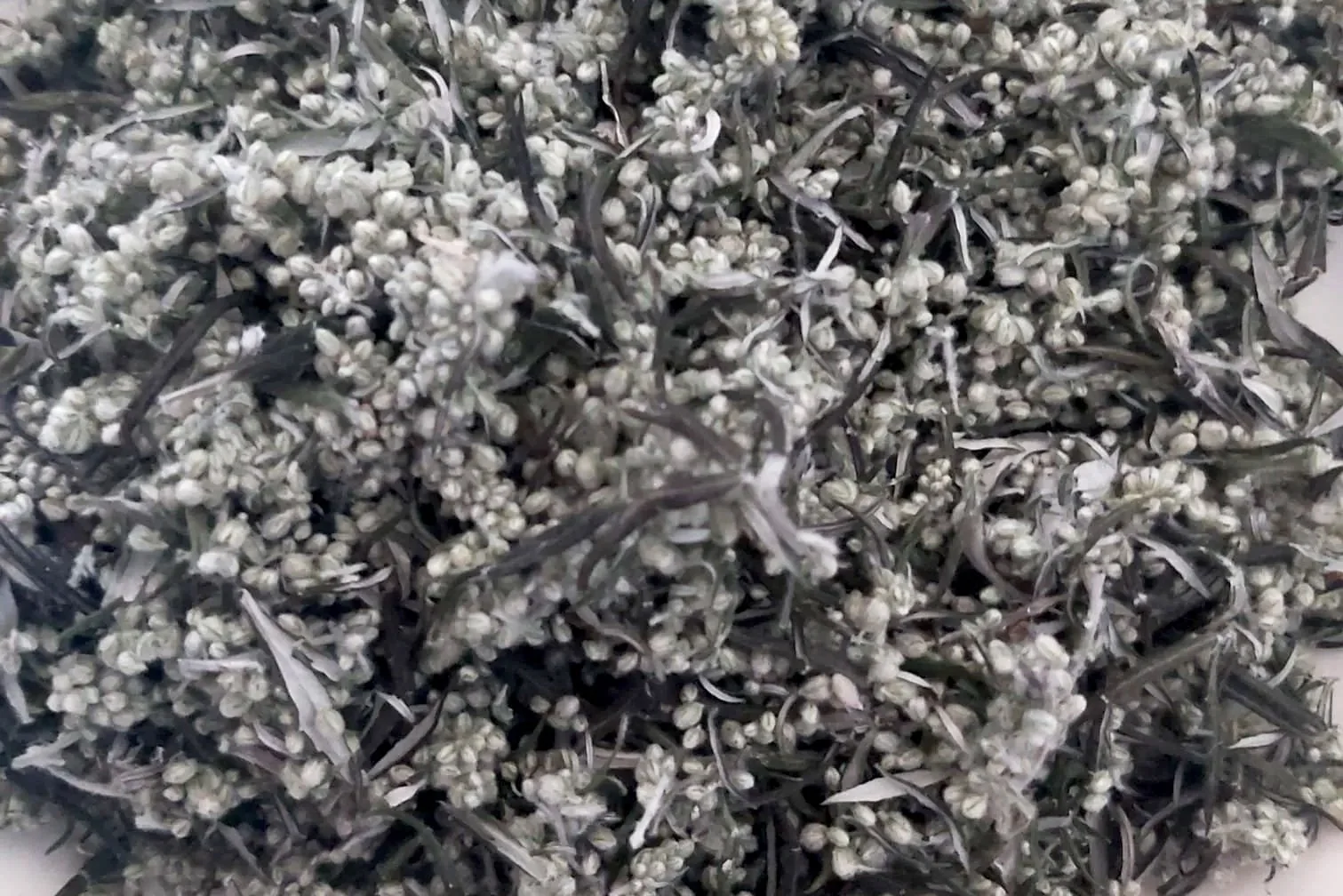
Dried Mugwort | Artemisia vulgaris
Before Hops, which are a sedative, were used in beer-making from around 800 AD, Mugwort was a popular brewing herb. If homebrewing is your thing, you can find recipes online to make your own Mugwort beer. Although I’ve not tried it myself, I imagine it would be quite a different experience to more soporific “hoppy” beers.
16th Century Austrian Physician, Paracelsus, said, “What is Venus other than the Mugwort growing in your garden”. In the ancient practice of medical astrology, Venus rules anatomy specific to women, and to this day, Mugwort is used to ease menstrual pain and irregularities in menstrual cycles, as well as given to women in labour. Please note, Mugwort should NOT be used during pregnancy.
Mugwort has warming and antispasmodic actions, meaning it helps to relax the nervous system and smooth muscle tissue — making it a champion herb not just for menstrual cramps, but tired legs and feet too, for the walkers out there.
This relaxant effect can help ease stress-related tension, which in turn can relieve digestive and sleep issues caused by stress. Although be warned, although Mugwort can help you get to sleep, a night of vivid dreaming doesn’t always feel restful!
The simplest way to enjoy Mugwort is a hot water infusion (also known as a cup of tea). Steep a couple of teaspoons of the fresh leaves and flowers for 10 —15 mins, strain, and add honey to taste. Enjoy!